

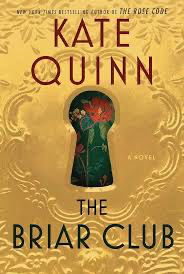
The Briar Club
Kate Quinn
5/5
Synopsis
A haunting and powerful story of female friendships and secrets in a Washington, D.C. boardinghouse during the McCarthy era.
Washington, D.C., 1950. Everyone keeps to themselves at Briarwood House, a down-at-the-heels all-female boardinghouse in the heart of the nation’s capital, where secrets hide behind white picket fences. But when the lovely, mysterious widow Grace March moves into the attic, she draws her oddball collection of neighbors into unlikely friendship: poised English beauty Fliss whose facade of perfect wife and mother covers gaping inner wounds; police officer’s daughter Nora, who is entangled with a shadowy gangster; frustrated baseball star Bea, whose career has ended along with the women’s baseball league of WWII; and poisonous, gung-ho Arlene, who has thrown herself into McCarthy’s Red Scare.
Grace’s weekly attic-room dinner parties and window-brewed sun tea become a healing balm on all their lives, but she hides a terrible secret of her own. When a shocking act of violence tears apart the house, the Briar Club women must decide once and for all: Who is the true enemy in their midst?
Capturing the paranoia of the McCarthy era and evoking the changing roles for women in postwar America, The Briar Club is an intimate and thrilling novel of secrets and loyalty put to the test.

Genre
Historical fiction/mystery
Content Warning
Violence, abuse, 1/5 sexual content
For a person who loves history, I don’t often pick up historical fiction. Don’t ask me why, I have no idea. But, I’d heard good things about The Briar Club, and I’d never read anything that took place in the 50’s, so I decided to give it a go. It did not disappoint! I highly recommend it, and I definitely will be reading more Kate Quinn in the future. I really appreciated at the end she noted her inspiration for each character came from various real-life people.
Things I Liked
Setting
The setting is really deeply rooted in the era and the house. The house was more than a setting; it was a character in itself. I loved it. The communist fear that gripped the USA in that era (the book takes place from 1950-1954) was so much more extreme than I realized. I’ve always known it was there, but I had no idea it was to the level expressed in the book.
While we’re talking about setting, I do have to say, I had a hard time with the town being named Foggy Bottom because my mind would not stop rerouting to Paw Patrol, and then I’d think of Mayor Humdinger, and it was a whole thing. #parentlife. It was interesting, though, having it set in a more residential area of D.C, so much of my knowledge of the area revolves around movies that take place there, and they’re usually in regards to The White House.
“Briarwood House is as old as the century. The house has presided—brick-fronted, four-storied, slightly dilapidated—over the square below for fifty-four years. It’s seen three wars, ten presidents, and countless tenants…”

Theme
The found family theme is one of my faves. What starts as begrudging weekly dinners turns into a group of people who would do anything to protect one another (for most of them at least). They learn to trust each other with some of their darkest secrets and their lives. Some of those secrets are so juicy! The way they rally around Pete and Lina, and help Fliss with Angela, really took that theme home.
I also love when female friendship is done so well. There are a few characters that just don’t get along, and I appreciate the accuracy. Not everyone likes each other, and that’s pretty normal. The friendships bloom slowly over the book; some take longer than others, and it results in a really beautiful story.
“The whole house came to Grace’s room on Thursday nights, but nearly every other evening she’d hear a knock from some member of the Briar Club hoping for a more private heart-to-heart.”
Chapters
I like how the chapters play out, starting with the end, but not as a prologue, because it’s from the house’s point of view. Then we go back to Pete, the son of the boardinghouse’s owner, and the arrival of Grace. Then we get to watch each character grow over the years, with all of the boardinghouse ladies getting their own chapter.
Characters
The characters were all lovely. I don’t think I could pick a favorite, but if I had to, I’d say Grace, probably because she’s the one who revives Briarwood House and the people in it, not to mention the story starts with her arrival. For such a big cast, each character has their own well done arch, and are well fleshed out. They Like I said before, the house also makes an appearance as a character, and I thought it was genius! It brought a sort of omniscient narrator feel, but with a vested interest. I also love the song “If These Walls Could Speak” by Amy Grant, so I was particularly fond of the house.
“Briarwood House remembers the moment Grace March dabbed that first painted flower on the green wall of Apartment 4B. There now, she’d asked, don’t you feel pretty? No one had asked the house a question in such a long time.”
Even though the book starts in 1954, and then we go back to 1950 and spend four years and nineteen chapters waiting for the reveal, the pace stayed steady and engaging. As for the big reveal, I didn’t see it coming. Even looking back after, there were small hints here and there, but I still wouldn’t have put those pieces together. Really well done, I love being surprised!
Things I Didn’t Like
Nothing. It was excellent from start to finish!
If you enjoyed this review, head on over to read about The Quarry Girls.
If you have a book you’d like to recommend, please leave a comment below! Happy Reading!